Dreaming of school: what does this dream mean?

In short
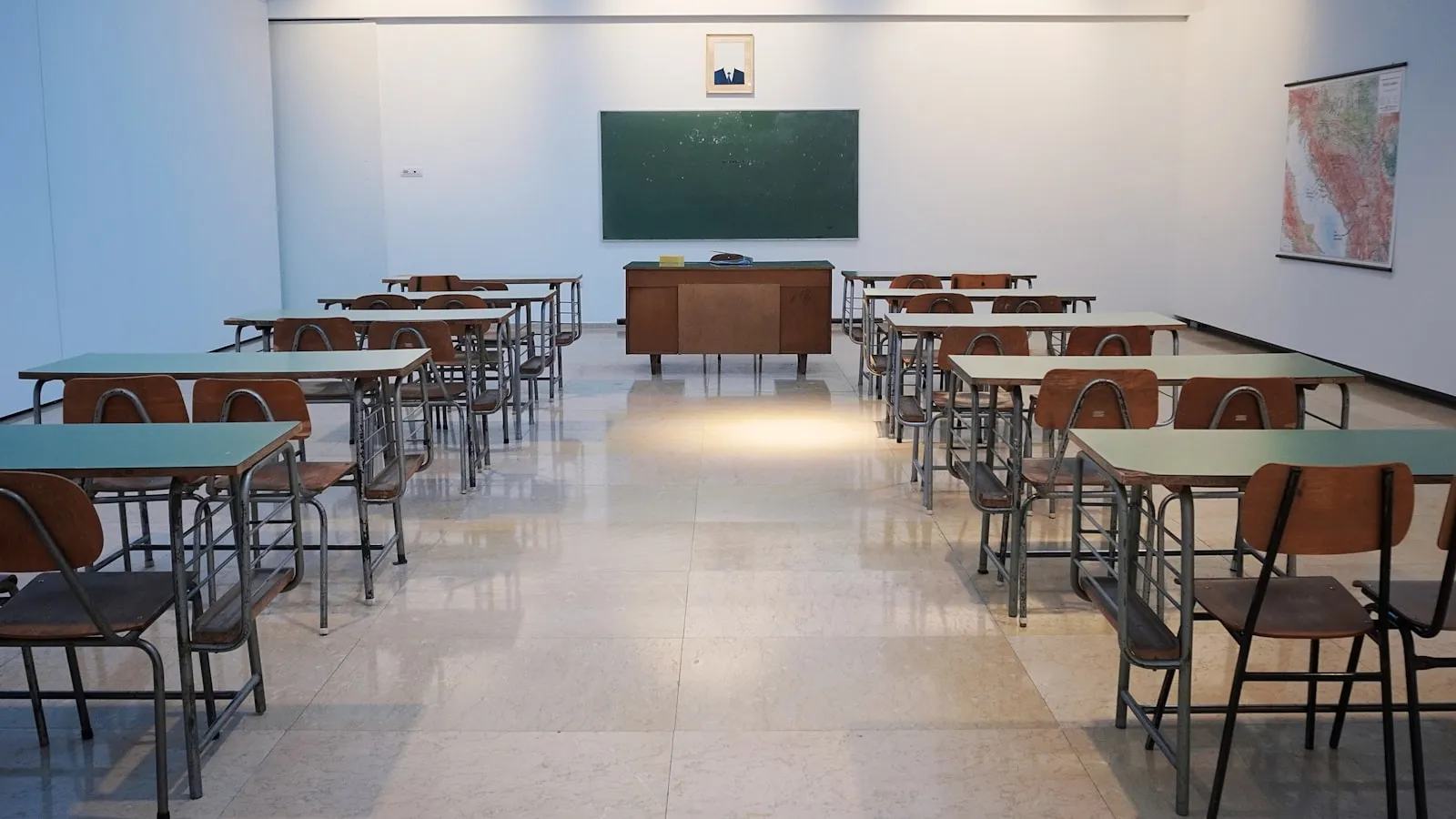
Few dream settings are as tenacious as the school. Adults who left their classrooms decades ago report returning to them night after night — scrambling for a locker combination they no longer remember, sitting down to an exam for a course they forgot to attend, or wandering corridors that somehow never end. The persistence of this setting is not coincidental. School was the first arena in which most people learned that their capacities would be measured, ranked, and publicly declared. Before the workplace, before romantic relationships, before civic life, the schoolroom established the emotional grammar of being evaluated — and the sleeping brain keeps borrowing that grammar whenever waking life presses the same buttons. Whether the school dream arrives as dread or nostalgia, it almost always asks the same underlying question: am I prepared, and am I enough?
What are the interpretations of this dream?
Psychoanalytic interpretation (Freud, Jung)
According to Sigmund Freud
Freud gave special attention to examination dreams — the category most tightly linked to the school setting — in 'The Interpretation of Dreams' (1900). He made a counterintuitive observation: examination dreams, even when experienced as nightmares of unpreparedness, almost exclusively revisit tests the dreamer actually passed. The unconscious, he argued, is not predicting failure but offering a disguised reassurance — reminding the dreamer that they have already survived comparable ordeals. The schoolroom concentrates a specific anxiety: the fear of being publicly found inadequate before a figure of authority. In Freudian terms, the teacher condenses parental and super-ego authority into a single examining presence, and the dread of failing the test is the socialised descendant of castration anxiety — shame and exposure before the judging gaze of the Other. Crucially, Freud noted that the triggering context for these dreams is almost always a real current challenge: a presentation, a job interview, a professional evaluation. The school is not a memory but a mechanism, the psyche's readiest shorthand for any situation that feels like a high-stakes test.
According to Carl Gustav Jung
For Jung, the school dream works on two levels simultaneously. At the personal level, it revisits the specific institutional experiences of childhood — the particular teacher whose approval mattered, the class where the dreamer felt most exposed. At the archetypal level, however, the school represents what Jung called an initiation structure: a bounded space where the unprepared self is tested, potentially transformed, and — if it survives — granted passage to the next stage. In 'The Archetypes and the Collective Unconscious' (1959), Jung described the recurring motif of returning to places of childhood trial as the psyche's way of signalling unfinished developmental work. The teacher figure in such dreams often carries qualities of the Wise Old Man or Woman archetype — not simply a super-ego enforcer but an inner guide whose demanding curriculum points toward growth. A dreamer who feels perpetually lost in a school that has grown incomprehensible may be encountering their own shadow: the parts of the self that were suppressed, shamed, or left undeveloped during the long years of institutional conformity.
Traditional and oneirocritic interpretation
In the Western oneirocritical tradition, dream interpretation was organised around the social meanings of places — and the school or academy occupied a distinct position. From early modern English dream manuals onward, the schoolroom was read as an omen of intellectual challenge and social scrutiny. 'To dream of being at school' in the popular almanac tradition of the 18th and 19th centuries typically forecast that the dreamer would soon be called upon to demonstrate their competence or character in a public setting. Being praised by a teacher augured professional advancement; being punished or shamed foretold setbacks in reputation or standing. The school was understood as a threshold institution — a place one passes through on the way to adult life — and so dreaming of it signalled transition, the approach of a new phase demanding unfamiliar capacities. Thomas Tryon's 'A Treatise of Dreams and Visions' (1689), one of the earliest English-language works to systematise dream interpretation, urged that dreams set in places of learning be read as provocations to the waking will: prompts to examine whether one's conduct and preparation matched the challenges ahead.
According to cultural and religious traditions
Tradition Protestant and Puritan tradition (Anglophone Britain and North America)
In communities shaped by the Protestant Reformation, education and religion were inseparable: literacy was a moral obligation because it enabled direct access to Scripture. The schoolroom was not a secular space but a sacred-secular one, presided over by values of diligence, accountability, and the right use of God-given capacities. Within this tradition, dream-interpreters read school dreams as reminders of stewardship — was the dreamer putting their talents to proper use? Failing a test in such a dream could carry a quality of spiritual reckoning quite distinct from social embarrassment, echoing the parable of the talents and the weight of divine judgment.
Tradition Classical Greco-Roman philosophical tradition
In the ancient world, the school (Greek skholē, literally 'leisure') was a space set apart from the pressures of commerce and politics for the cultivation of the mind. Artemidorus of Daldis, in his 'Oneirocritica' (2nd century CE), interpreted dreams involving places of philosophy and rhetoric as signs of intellectual ambition, potential public recognition, or the need for wise counsel. To dream of sitting at the feet of a renowned teacher was an auspicious omen for anyone whose waking work involved persuasion or public discourse. The dreamer was, in effect, being reminded of the sources of their own wisdom.
Tradition Contemporary secular Western culture
The modern secularised school dream has shed much of its religious freight but retains its emotional core. Ann Faraday, in 'The Dream Game' (1974), observed that the examination scenario had become the dominant form of the school dream in post-war Western adults — a direct reflection of a culture that had internalised the logic of credentials, performance metrics, and comparative ranking. The school, in this reading, is the institution that first teaches the difference between what you are and how you score — and the adult who dreams of failing an exam is working through the gap between those two things.
Dreaming of school: what does the context mean?
| Dream situation | Interpretation |
|---|---|
| Sitting an exam you have not prepared for | The most prevalent school dream scenario across cultures and generations. Calvin S. Hall's large-scale empirical study of dream content, 'The Meaning of Dreams' (1953), identified unprepared-exam dreams as among the most cross-culturally consistent patterns in the adult dream record. The dream is rarely about schoolwork itself; it maps directly onto a current real-life situation in which the dreamer feels that they may be judged and found inadequate — a performance review, a creative deadline, a social audition. The psyche borrows the examination hall because that was where the dreamer first learned what it felt like to be evaluated under time pressure. |
| Wandering through empty or labyrinthine school corridors unable to find the right room | Spatial disorientation within the school building is a distinct variant with its own emotional signature: not the acute dread of the exam, but a diffuse, directionless unease. The dreamer cannot locate themselves within the institution's structure. This tends to emerge during periods of vocational uncertainty or identity transition — when the dreamer does not yet know which 'subject' they are supposed to be studying next, or which role they are supposed to occupy. Ernest Hartmann's continuity hypothesis frames these dreams as the sleeping mind replaying the emotional tone of aimlessness that pervades waking life. |
| Returning to school as a fully grown adult surrounded by children | The temporal mismatch is the heart of this scenario: the dreamer knows they are an adult but finds themselves placed back at the beginning, among those who have not yet begun. This can carry both a deflating and a quietly positive charge. The deflating reading is regression anxiety — the fear of having lost ground professionally or emotionally, of being sent back to square one. The positive shadow is a longing for the structured guidance, clear milestones, and permission to be a beginner that adult life rarely extends. Which reading fits depends heavily on whether the dream atmosphere is humiliating or surprisingly comfortable. |
| Being the teacher, supervising or leading others in the school | A reversal of the standard anxiety configuration. When the dreamer occupies the position of authority — standing at the front of the classroom, setting the questions rather than answering them — it typically reflects a genuine shift in waking-life role: the assumption of mentorship, leadership, or expert status. In Jungian terms, this is a marker of psychological maturation, the moment when the inner pupil gives way to the inner guide. The emotional quality of the dream is telling: a teacher who feels confident signals integration; one who feels fraudulent or overwhelmed signals unfinished work in claiming that authority. |
| A school environment that feels menacing, hostile, or socially treacherous | When the school setting is coloured not by examination anxiety but by a more diffuse social threat — bullying, exclusion, a hostile teacher, an atmosphere of surveillance — the dream is more likely drawing on unresolved interpersonal material from childhood institutional experience, or mapping current workplace dynamics onto the most legible template available. Ann Faraday argued that these dreams repay direct waking attention to the specific relationships and power structures they portray, because the school is being used as a displacement for something in present life that feels structurally similar but harder to name. |

What does school symbolize in dreams?
The school's symbolic force in dreams derives from a simple but structurally profound fact: it was the first institution most people encountered that measured them against a standard they did not set. At home, worth can be assumed; at school, it must be demonstrated — repeatedly, publicly, and in competition with others. This makes the school the psyche's original theatre of self-evaluation, and that theatre remains open long after the building has been left behind. Its specific architectural features encode specific psychological pressures. The corridor is the space of transition and purposeful movement, and to be lost in one signals lost direction. The classroom is the bounded arena of structured knowledge — a place where there are right and wrong answers, where ambiguity is not tolerated, which makes it a profound contrast to the open-ended murkiness of adult experience. The bell announces deadline and interruption, the sudden end of whatever preparation time remained. The examination hall compresses all of this into a single moment of irreversible assessment. Ernest Hartmann, in 'Dreams and Nightmares' (1995), noted that emotionally charged central images in dreams tend to cluster during periods of psychological upheaval; the school is perhaps the most culturally portable of these images because it encodes the emotional logic of scrutiny in a form recognisable across generations and backgrounds. To dream of school is ultimately to dream about the relationship between one's private sense of capability and the world's demand for proof of it — and whether, when the time comes, those two things will match.
Frequently asked questions
- Why do adults dream about school for decades after graduating?
- Because the school was the first setting in which the psyche systematically experienced public evaluation, social comparison, and the anxiety of performance under time pressure. Ernest Hartmann's continuity hypothesis proposes that the emotional concerns dominating waking life are replayed in sleep using the most emotionally loaded settings from the dreamer's past. School provided the original template for 'being judged,' and so whenever professional pressure, perfectionism, or imposter syndrome surfaces in adult life, the sleeping mind returns to its earliest arena for working through that emotional register.
- Freud said examination dreams are actually reassuring — is that right?
- Yes, with some nuance. Freud observed in 'The Interpretation of Dreams' (1900) that examination dreams almost always revisit tests the dreamer actually passed, never ones they failed. He interpreted this as a covert self-reassurance from the unconscious: 'You passed this before; you will survive the current ordeal too.' The manifest content is anxious, but the latent logic is consoling. That said, this does not mean the dream has nothing to tell the dreamer — the urgency of the anxiety still points toward a real current challenge that deserves waking attention.
- What does it mean to dream of a school I never actually attended?
- An unfamiliar school points more clearly toward the archetypal dimension of the symbol — the universal 'place of testing and initiation' rather than a specific autobiographical memory. Jung would read this as the psyche constructing a neutral arena, stripped of personal history, for working through a developmental challenge. When the building is entirely fictional, the dream is less about the past and more about the present: the dreamer is in genuinely new psychological territory, entering a phase of learning or self-discovery that their personal experience offers no ready map for.
Sources and references
- Freud, Sigmund. The Interpretation of Dreams. (1900). Trans. James Strachey. Basic Books, 1955.
- Jung, C. G. The Archetypes and the Collective Unconscious. Collected Works Vol. 9i. Princeton University Press, 1959.
- Hall, Calvin S. The Meaning of Dreams. Harper & Brothers, 1953.
- Faraday, Ann. The Dream Game. Harper & Row, 1974.
- Hartmann, Ernest. Dreams and Nightmares: The New Theory on the Origin and Meaning of Dreams. Plenum Press, 1995.
- Artemidorus of Daldis. Oneirocritica. (2nd century CE). Trans. Robert J. White. Noyes Press, 1975.
- Tryon, Thomas. A Treatise of Dreams and Visions. 1689.
Comments
…