Dreaming of cemetery: what does this dream mean?
In short
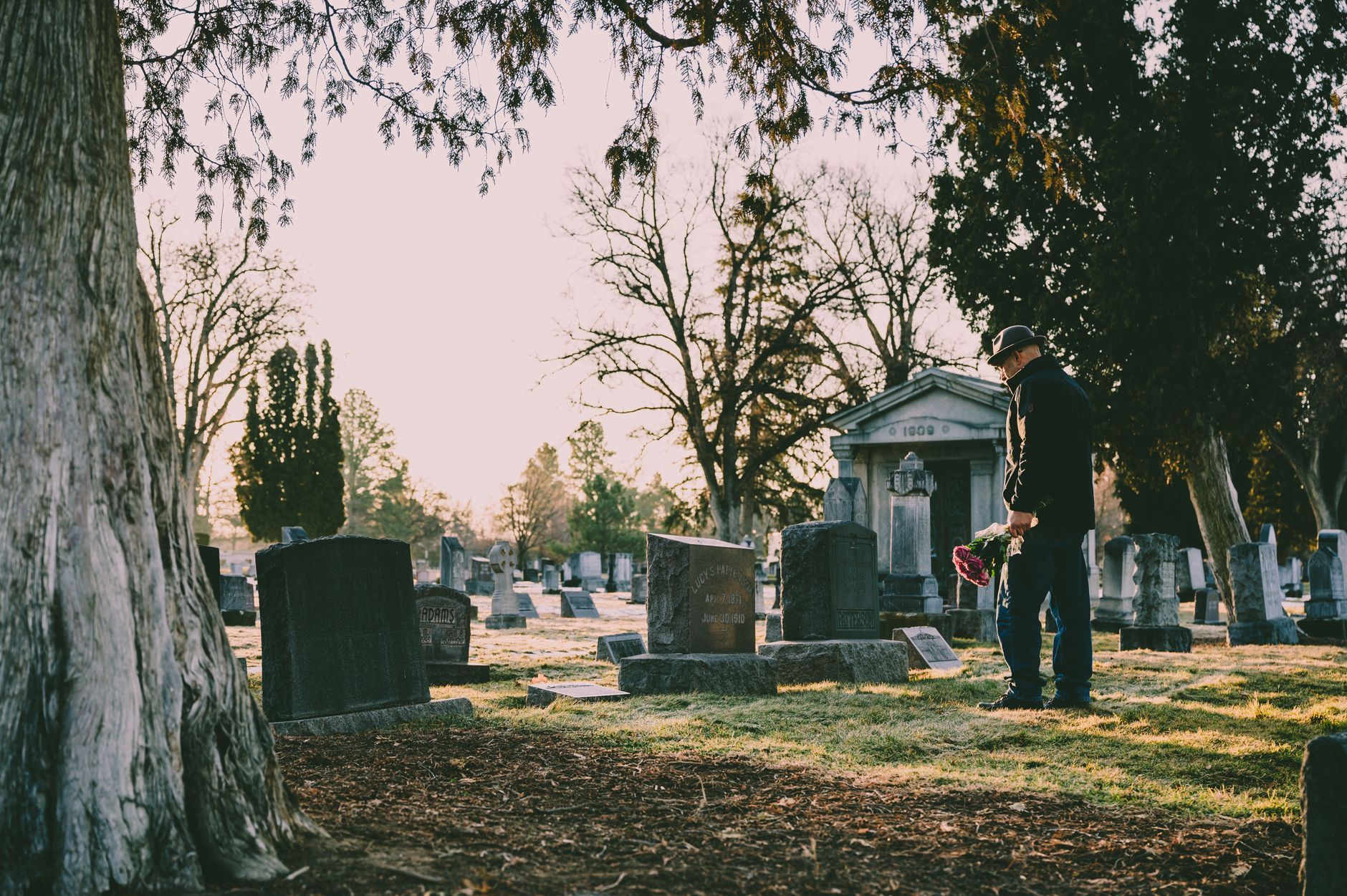
Dreaming of a cemetery rarely signals literal death or disaster. Instead, it almost universally points to inner processes of ending, transformation, memory, and unfinished emotional business. The cemetery is one of the most richly layered dream settings in Western oneiric tradition: a liminal space standing at the boundary between the living and the dead, the conscious and the unconscious, the present and the irrecoverable past. Whether the dreamer feels dread, peace, or a strange curiosity upon waking depends far more on the emotional texture of the dream than on the cemetery itself — a distinction that every serious interpreter, from Freud to Ann Faraday, has consistently emphasized.
What are the interpretations of this dream?
Psychoanalytic interpretation (Freud, Jung)
According to Sigmund Freud
For Freud, the cemetery is intimately linked to the death drive (Thanatos) and to the dreamer's relationship with loss and grief. In 'The Interpretation of Dreams' (1900), Freud argued that manifest images of death rarely express a literal wish for dying but rather encode displaced feelings — jealousy, guilt, or the desire to be free of a suffocating relationship. A cemetery scene may therefore represent a repressed wish that a troublesome person or situation would simply disappear from one's life, or, conversely, an unprocessed mourning for something the dreamer has already lost. The tombstones become symbolic markers for buried affects: feelings that have been interred rather than worked through.
According to Carl Gustav Jung
Jung's reading diverges significantly from Freud's. In his framework, the cemetery functions as a threshold to the collective unconscious — a place where the personal shadow and ancestral memory converge. Encountering a cemetery in a dream may indicate that the Self is calling the dreamer to engage with the parts of the psyche that have been 'put to rest' prematurely: unlived aspects of the personality, abandoned creative impulses, or inherited family patterns. Jung saw such dreams as potentially numinous, especially when the dreamer experiences awe rather than terror. The cemetery can be a site of *individuation*, where confronting what has died paradoxically releases new psychic energy.
Traditional and oneirocritic interpretation
In classical Western dream manuals, going back as far as Artemidorus's 'Oneirocritica' (2nd century CE) and carried forward through English-language almanac traditions of the 17th and 18th centuries, a cemetery dream was most commonly read as an omen of major life transition rather than physical death. Walking calmly through a graveyard suggested a peaceful resolution of a long-standing conflict or the honorable completion of a chapter of life. Running through one in fear warned of unresolved guilt or debts left unpaid — emotional or financial. Tending graves was widely interpreted as a sign of loyalty to one's heritage, while discovering an unknown grave pointed to a hidden aspect of the self waiting to be acknowledged.
According to cultural and religious traditions
Tradition Anglo-American Protestant folklore
In 19th-century American and British folk belief, dreaming of a well-kept, sunlit cemetery was considered a fortunate sign: souls rested peacefully, ancestors were satisfied, and the dreamer enjoyed their protection. A neglected or flooded graveyard, by contrast, signaled that ancestral matters demanded attention — prayers were owed, or old family disputes needed settling. This tradition is documented in collections such as Wayland Hand's 'Popular Beliefs and Superstitions' and echoes widely in Appalachian and New England oral lore.
Tradition Día de los Muertos (Mexican-American cultural tradition)
Although rooted in Mesoamerican and Catholic syncretic practice, Día de los Muertos imagery has become part of shared North American cultural consciousness. In this tradition, the cemetery is far from morbid: it is a festive meeting place between the living and the dead. Dreaming of a cemetery decorated with marigolds and candles therefore carries connotations of joyful reunion, continuity of family bonds, and the comfort of being remembered. This positive reading contrasts sharply with Protestant-derived anxiety and is relevant for many English-speaking dreamers in the Americas.
Tradition Gothic literary tradition (English Romanticism)
The English Gothic tradition — from Gray's 'Elegy Written in a Country Churchyard' (1751) to Keats and the Victorian graveyard poets — shaped a cultural dreamscape in which the cemetery represents sublime melancholy, the beauty of transience, and the poet's confrontation with mortality. For dreamers steeped in English literature, a cemetery may unconsciously evoke this tradition of productive grief: sorrow that deepens rather than paralyzes the living.
Dreaming of cemetery: what does the context mean?
| Dream situation | Interpretation |
|---|---|
| Walking peacefully alone through a tidy cemetery on a bright day | A sign of psychological integration and acceptance. The dreamer has likely reached a place of genuine peace with a past loss, a concluded relationship, or an earlier version of themselves. This image often appears during or after successful mourning processes. |
| Being chased or feeling trapped inside a cemetery at night | Classic anxiety dream. The dreamer is evading a reckoning with something unresolved — a relationship, a decision, a grief postponed. The enclosing walls and darkness amplify the sense that there is no escape from an internal confrontation that must eventually be faced. |
| Recognizing the name on a gravestone as one's own | Not literally ominous. This image most commonly signals a powerful desire for transformation — the symbolic death of the current self to allow a new identity or life chapter to emerge. It may also indicate burnout or a feeling that one's authentic self has been suppressed for too long. |
| Tending, cleaning, or planting flowers on a grave | Points to active, healthy grief work. The dreamer is honoring what has passed rather than denying it. Ann Faraday, in 'The Dream Game' (1974), emphasized that productive engagement with loss imagery in dreams reflects the ego's capacity to metabolize difficult experience. |
| Attending a funeral or ceremony in a cemetery with others | Highlights the communal dimension of endings. The dreamer may be processing a shared loss — the death of a relationship, a group identity, or a collective chapter — and seeking permission from their inner world to grieve alongside rather than alone. Ernest Hartmann's research on boundary permeability in dream content suggests this type of social funeral dream is more common among highly empathic individuals. |
What does cemetery symbolize in dreams?
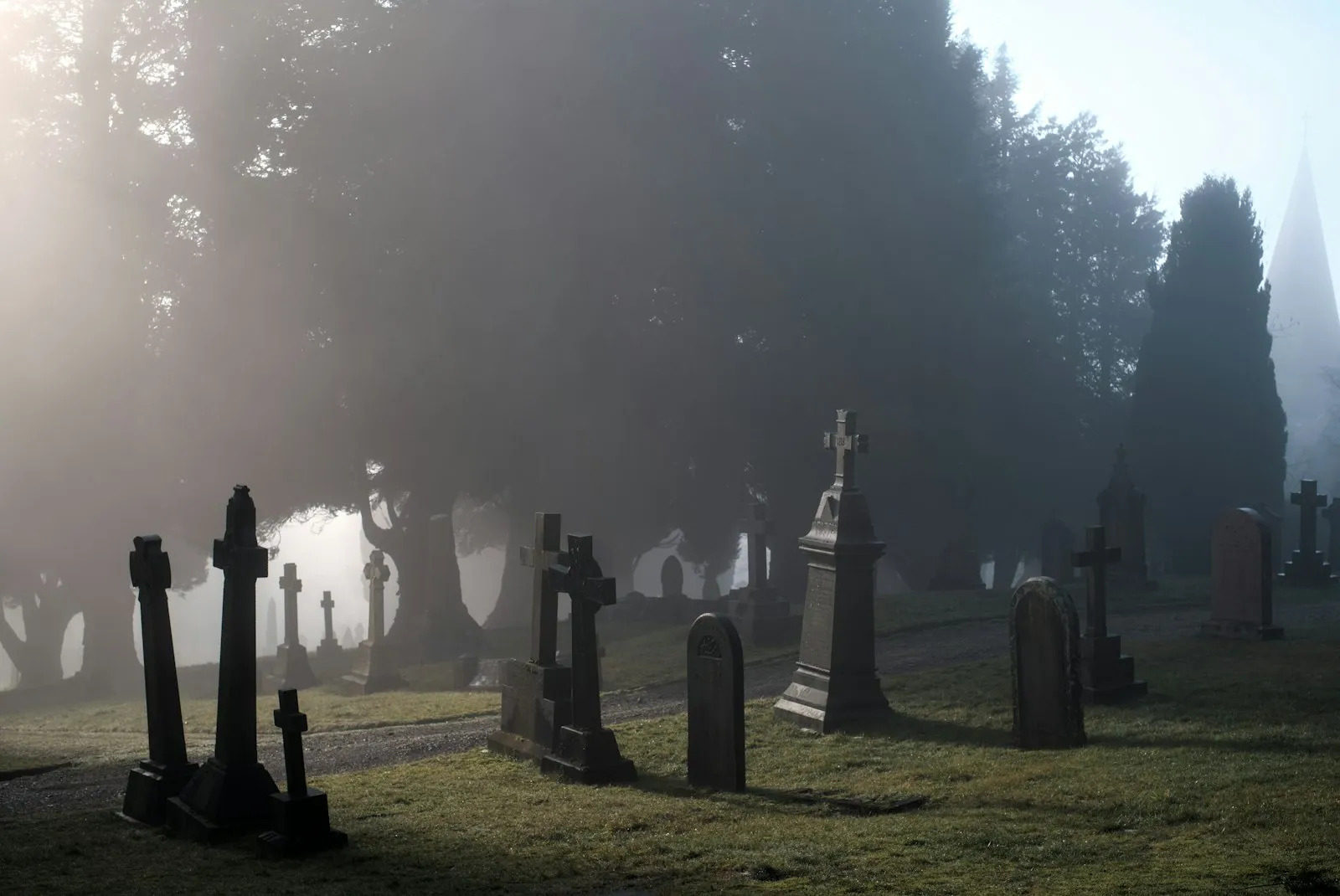
The cemetery condenses several of the most fundamental human tensions into a single space: life and death, permanence and decay, individual identity and collective memory. Its stones are language — naming the dead keeps them present; erasing a name is the final erasure. In dreams, this symbolic density means the cemetery rarely means only one thing. It holds past selves, lost loves, buried ambitions, and ancestral legacies simultaneously. The gates of a cemetery — open or locked — are particularly charged: an open gate invites the dreamer inward, toward encounter; a locked gate suggests that access to grief, memory, or transformation is being denied. The condition of the grounds matters as well: a manicured English churchyard evokes order and social continuity, while an overgrown, fog-shrouded burial ground signals something neglected, forgotten, or actively suppressed.
Frequently asked questions
- Does dreaming of a cemetery mean someone I love is going to die?
- No. This is the most persistent popular misconception about cemetery dreams, and virtually every serious researcher in modern dream study — from Calvin S. Hall's large-scale content analyses in 'The Content of Dreams' (1966) to Ann Faraday's clinical observations — confirms that death imagery in dreams is overwhelmingly symbolic rather than predictive. Cemetery dreams most commonly point to inner transitions, unresolved grief, or the need to 'let go' of something in waking life.
- Why do cemetery dreams sometimes feel strangely calm or even beautiful?
- Because the cemetery is not only a place of endings but of memory, honor, and continuity. Many dreamers report a serene, even luminous quality to these dreams, particularly when they are processing grief constructively or reaching a point of acceptance. Jung would describe this as the numinous quality of the archetype: the psyche recognizes that what appears to be about death is actually about transformation and the ongoing life of the Self.
- I keep having recurring cemetery dreams. What does that suggest?
- Recurrence strongly suggests that the underlying theme — unresolved loss, an avoided life change, suppressed mourning — has not yet been addressed in waking life. Ernest Hartmann's research on traumatic and emotionally intense dreams ('Dreams and Nightmares', 1998) links recurring symbolic settings to persistent emotional concerns that the dreaming mind continues to rehearse until they receive conscious attention. Journaling, therapy, or a deliberate ritual of closure around the identified loss often reduces or resolves the recurrence.
Sources and references
- Freud, Sigmund. The Interpretation of Dreams (Die Traumdeutung). Franz Deuticke, 1900. Standard Edition translated by James Strachey, Hogarth Press, 1953.
- Jung, Carl G. The Archetypes and the Collective Unconscious. Collected Works Vol. 9i. Princeton University Press, 1959.
- Hall, Calvin S., and Van de Castle, Robert L. The Content of Dreams. Appleton-Century-Crofts, 1966.
- Faraday, Ann. The Dream Game. Harper & Row, 1974.
- Hartmann, Ernest. Dreams and Nightmares: The New Theory on the Origin and Meaning of Dreams. Plenum Trade, 1998.
- Hand, Wayland D. (ed.). Popular Beliefs and Superstitions from North Carolina. Duke University Press, 1961–1964.
- Artemidorus of Daldis. Oneirocritica (The Interpretation of Dreams). Translated by Robert J. White, Noyes Press, 1975.
Comments
…