Dreaming of snake: what does this dream mean?
In short
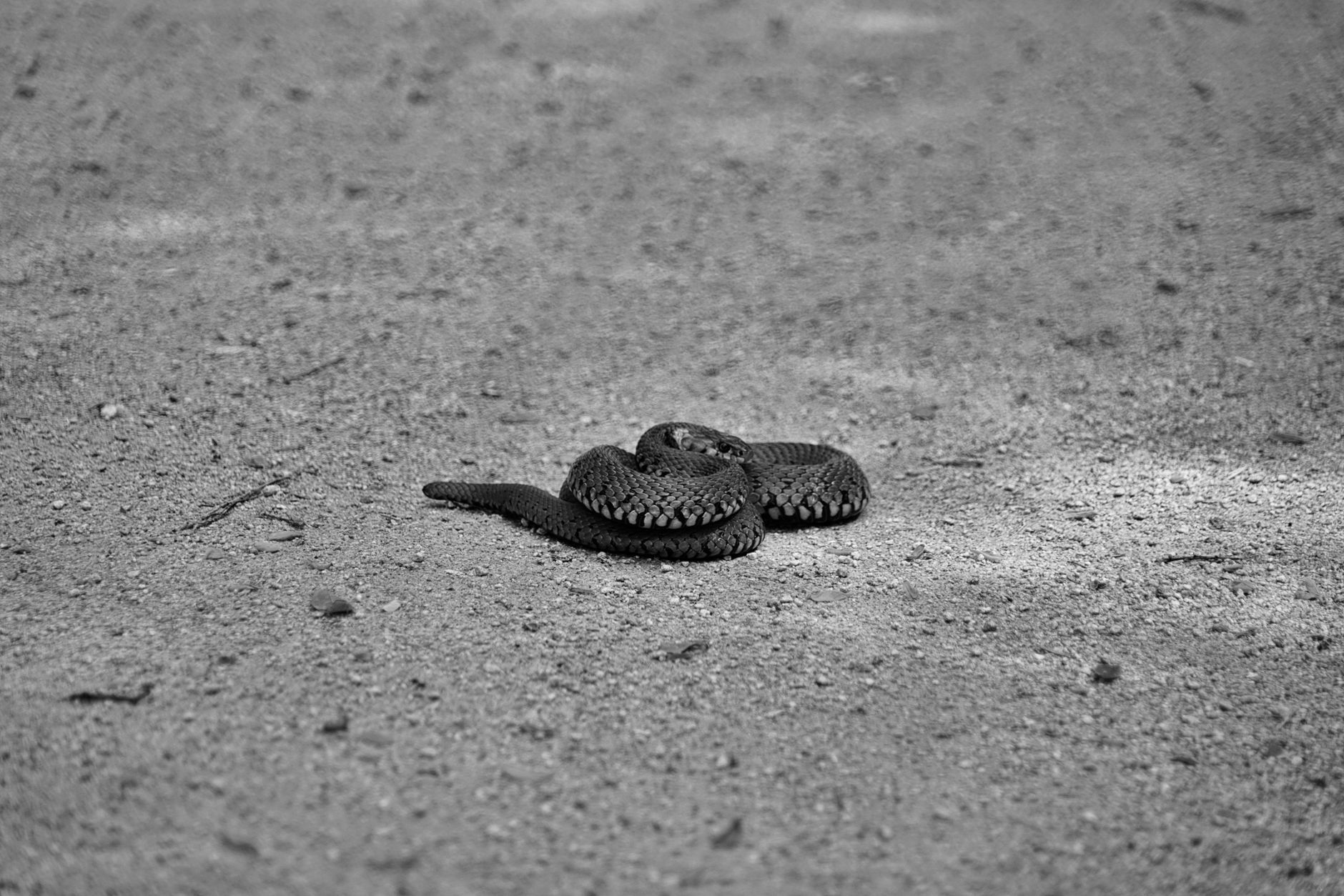
Dreaming of a snake most often points to an inner transformation already underway, a fear pushed out of sight, or a raw vital energy looking for a way to surface. This deeply ambivalent symbol can equally stand for someone in your life you sense as deceitful or dangerous. Its meaning shifts sharply with the details of the dream: the snake's colour, its behaviour, and above all the feeling it stirs in you.
What are the interpretations of this dream?
Psychoanalytic interpretation (Freud, Jung)
According to Sigmund Freud
For Sigmund Freud the snake is the phallic symbol par excellence, one of the most recurrent images in the whole literature of dreams. In The Interpretation of Dreams (1900) he ties the snake to repressed sexual drives and, in certain configurations, to castration anxiety. Being bitten by a snake can voice an unconscious dread of sexuality, or a tension bound up with an authority figure experienced as threatening. The mixture of fascination and fear that snakes so often provoke in dreams expresses the classic Freudian ambivalence between desire and prohibition: the dreamer is drawn toward what they have been taught to forbid themselves, and the snake becomes the disguised face of that forbidden wish.
According to Carl Gustav Jung
Carl Gustav Jung offers a strikingly different and more layered reading. In his analytical psychology the snake is first of all an archetype of the collective unconscious, carrying a dual and ambivalent meaning: it is at once a chthonic creature, bound to the earth and to death, and a symbol of transformation and regeneration, since it sheds and renews itself. Jung repeatedly links the snake to the transcendent function and to the raw psychic energy of the unconscious. In Psychology and Alchemy he reads the alchemical serpent, the ouroboros that bites its own tail, as an emblem of cyclical wholeness and of the totality of the Self. To dream of a snake, on this view, may signal that a deep transformation is at work in the psyche, an energy striving to reconcile and integrate opposites the conscious mind has kept apart.
Traditional and oneirocritic interpretation
In the older tradition of dream divination, notably in Artemidorus of Daldis (2nd century, the Oneirocritica), the snake carries varied meanings according to its behaviour and the dreamer's circumstances. A snake coiled around the body could foretell illness or a dangerous entanglement; a fleeing snake, a threat moving away. English and broader Western folk tradition has long read the dream snake as the sign of a hidden enemy, an approaching betrayal, or a two-faced person close at hand, an association reinforced by the proverbial 'snake in the grass'. The animal's stealth, its sinuous discretion, and its habit of appearing without warning have fed, since antiquity, the idea of a dream meant to caution the sleeper about the dangers lurking in their social world.
According to cultural and religious traditions
Tradition Christianity
In the Judeo-Christian imagination the serpent bears the weight of the Fall: it is the serpent that tempts Eve in the garden of Eden (Genesis 3), embodying cunning, temptation, and evil. To dream of a snake can therefore echo a moral temptation or a sense of guilt. Yet the same tradition preserves a redemptive serpent as well: the bronze serpent that Moses raises on a pole in the wilderness (Numbers 21), a figure of healing and deliverance that the Gospel of John later reads as a prefiguration of Christ. The ambivalence runs right through the biblical text itself.
Tradition Celtic and Norse tradition
In Norse myth the world-serpent Jormungandr encircles the earth, biting its own tail until it stirs at Ragnarok, joining the snake to ideas of cosmic boundary, hidden tension, and inevitable upheaval. Older Celtic and pre-Christian British lore associated serpents with the earth, with healing springs, and with seasonal renewal, an echo of which survives in the 'serpent stones' of British folk medicine. Read through this lineage, a snake dream can point less to evil than to the turning of a cycle, a buried force in the land of the psyche rising toward its season of change.
Tradition Asian symbolism
Across many Asian traditions, Hindu, Buddhist, and Taoist alike, the snake is a figure of wisdom and cosmic power. The Hindu Naga is a celestial half-human, half-serpent being, guardian of the waters and of hidden knowledge. In the Chinese zodiac the snake is one of the twelve signs, associated with insight, intuition, and allure. Within yogic and tantric thought the coiled serpent of kundalini represents dormant vital energy resting at the base of the spine, waiting to rise. To dream of a snake in this frame can mark a contact with deep wisdom, or an awakening of life-force that has lain still.
Dreaming of snake: what does the context mean?
| Dream situation | Interpretation |
|---|---|
| a black snake | A black snake heightens the shadow and unconscious dimension of the dream. In Jungian terms black evokes what is repressed, concealed, or not yet brought into awareness. The dream may be pointing to a part of yourself you would rather not face, or to a darker emotion, anger, jealousy, deep fear, that is asking to be acknowledged rather than buried further. |
| a snake that bites | A snakebite in a dream often dramatises a wound being inflicted in waking life: a cutting remark, a betrayal, a toxic relationship that 'strikes' at you. In Freudian terms it can also voice sexual anxiety or a fear of being dominated. Just as often it marks a rude awakening, a painful but necessary realisation that breaks through your defences. |
| a white snake | The white snake is linked in many traditions to purity, wisdom, and the benevolent forces of change. It usually reads as a favourable sign: a healing on the way, an inner clarity coming into focus, or the resolution of a long-standing conflict. In several folk and Eastern readings the white serpent is explicitly a good omen. |
| killing a snake | Killing a snake in a dream generally signals a victory over a fear, a threat, or a toxic situation. You overcome what had been pressing on you, whether a difficult relationship, an inner block, or a stretch of anxiety. It is among the most positively interpreted of all snake dreams across divinatory traditions. |
| many snakes | Seeing many snakes multiplies the symbolic charge. Depending on the dream it can suggest problems piling up, a sense of being surrounded by ill-willed people, or, conversely, an abundance of vital energies all transforming at once. The fear you feel within the dream is usually the clearest guide to which of these two readings applies. |
| a giant snake or python | A giant snake or a python that coils and constricts often stands for intense oppression: a problem of crushing size, a smothering relationship, or an anxiety that quite literally grips you. It can also represent an exceptional psychic energy that you are still struggling to integrate or to master. |
What does snake symbolize in dreams?
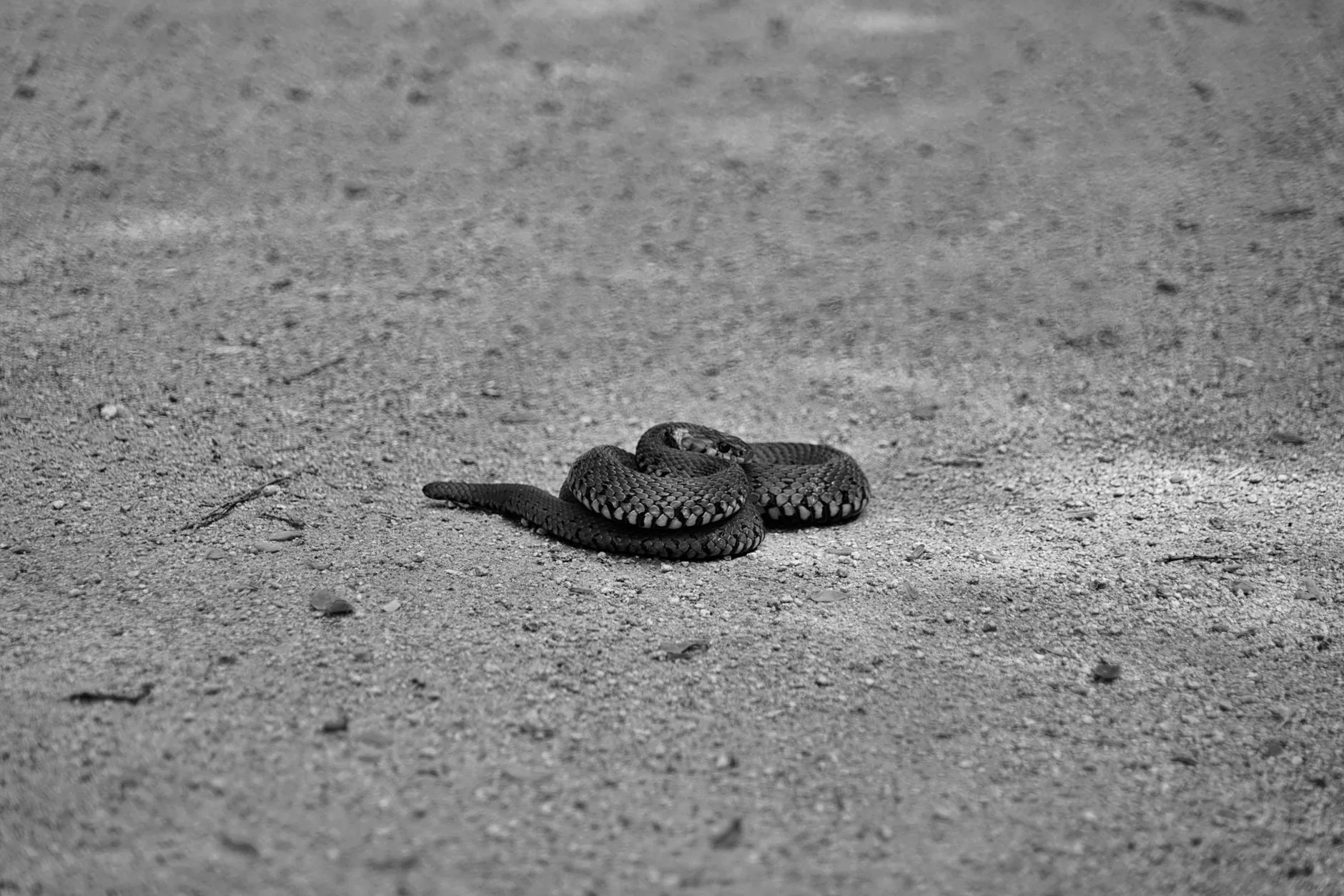
The snake is one of the most charged and universal images in the human imagination, present in nearly every culture from the earliest civilisations onward. Its symbolic force draws on several of its biological traits. It sheds its skin, which makes it a natural emblem of renewal and rebirth. It is venomous, holding the twin power to kill and to heal, since the very toxin that poisons can also be refined into an antidote. It moves in silence and strikes from nowhere, an apt figure for hidden danger and for the unconscious itself. And its sinuous form has, since antiquity, been linked to the phallus, the winding river, and the serpentine road of fate. In Jung's collective unconscious the snake belongs to the most archaic and most heavily loaded stratum of the psyche, embodying a set of fundamental dualities: life and death, good and evil, knowledge and danger, earth and sky. The physician's caduceus and the rod of Asclepius, with serpents coiled around a staff, capture this ambivalence perfectly: what poisons may also cure. This is why a single snake dream can read as warning and promise at once, and why no two dreamers should expect the same meaning.
Frequently asked questions
- Is dreaming of a snake a bad omen?
- Not necessarily. Across every tradition the dream snake is an ambivalent symbol: it can herald a positive transformation just as readily as a threat. The emotion you feel during the dream, fear, fascination, or calm, is usually the best guide. A menacing snake you flee from points more to a heavy situation that needs resolving; a snake that ignores you or slides away can signal a threat that is fading.
- Why do we dream about snakes so often?
- Snakes are among the most frequent symbols in human dreams across all cultures. Evolutionary anthropologists and psychologists, notably Lynne Isbell in The Fruit, the Tree, and the Serpent (2009), have argued that our brains may be specially primed to detect snakes, an inheritance from primate ancestors who lived alongside dangerous reptiles. That bias would help explain why the unconscious reaches so readily for this image when working through fear or deep change.
- What does it mean to dream of a talking snake?
- A talking snake sharply amplifies the symbolic weight of the dream. In the Judeo-Christian tradition it is the very motif of Genesis, the tempter who speaks. Psychologically it can mean that your unconscious is trying to deliver an important message, often tied to a truth you have repressed or a realisation you keep postponing. The snake's words are worth holding onto and turning over.
- Does dreaming of a snake mean I have an enemy?
- This is one of the most widespread traditional readings, common in Western folklore and in classical dream divination. But it is not universal. Before concluding that someone has betrayed you, look inward: is there a situation, a relationship, or a part of yourself that you fear or avoid? The 'snake' may well live inside you.
- What does it mean to dream of a snake during pregnancy?
- Snake dreams are common in pregnancy, a time of intense bodily and psychic transformation. Several traditions link the serpent to fertility and life. Psychologically the dream often mirrors the profound, and sometimes unsettling, changes the expectant mother is living through. There is no automatic negative omen here; the dream expresses the sheer magnitude of the transition underway.
- What does it mean to kill a snake in a dream?
- Killing a snake is usually read positively: a victory over a fear, a threat, or a toxic situation. In several divinatory traditions it foretells success against an adversary. In psychoanalytic terms it can signal that you have found the resources to confront something you had been avoiding until now.
Sources and references
- Freud, S. (1900). The Interpretation of Dreams. Trans. James Strachey, Avon Books, 1965.
- Jung, C. G. (1964). Man and His Symbols. Doubleday/Anchor, 1988.
- Jung, C. G. (1944). Psychology and Alchemy (Collected Works, Vol. 12). Trans. R. F. C. Hull, Princeton University Press, 1968.
- Artemidorus (2nd c. AD). The Interpretation of Dreams (Oneirocritica). Trans. Robert J. White, Noyes Press, 1975.
- Isbell, L. A. (2009). The Fruit, the Tree, and the Serpent: Why We See So Well. Harvard University Press.
- Chevalier, J. & Gheerbrant, A. (1996). The Penguin Dictionary of Symbols. Trans. John Buchanan-Brown, Penguin Books.
- Garfield, P. (2001). The Universal Dream Key: The 12 Most Common Dream Themes Around the World. HarperCollins.
Comments
…