Dreaming of rain: what does this dream mean?

In short
Rain is one of the most universally recognized symbols in the dream world, appearing across cultures and centuries as a sign of both renewal and emotional turbulence. Unlike many dream symbols that carry a fixed charge, rain resists easy categorization: it can wash away grief, herald creative fertility, or signal a psyche overwhelmed by unfelt emotions. Whether you dream of a soft summer drizzle, a drenching downpour, or a violent storm, the meaning shifts with context, feeling, and the dreamer's own life circumstances. Dream researchers from Freud to Ann Faraday have noted that rain consistently attracts projection — we pour into it whatever we most need to express or release.
What are the interpretations of this dream?
Psychoanalytic interpretation (Freud, Jung)
According to Sigmund Freud
For Freud, water in general — and rain in particular — carried strong sexual and libidinal associations. In 'The Interpretation of Dreams' (1900), Freud links fluid imagery with repressed desire and the release of unconscious tension. Rain falling from above could represent the release of pent-up urges, while shelter sought from rain might symbolize a wish for maternal protection or a return to a contained, safe state. A dream in which the dreamer is soaked through against their will may reflect anxiety about losing control over instinctual drives.
According to Carl Gustav Jung
Jung situated rain within his concept of the collective unconscious as a symbol of psychic nourishment and individuation. In 'Man and His Symbols' (1964), Jung's collaborators describe precipitation as an archetypal image of the Self fertilizing the conscious mind — the sky (spirit, transcendence) communicating with the earth (the body, the material world). Dreaming of rain may therefore signal a compensatory message from the unconscious: the psyche is attempting to replenish areas of the dreamer's inner life that have become parched, rigid, or cut off. A storm, by contrast, may represent the eruption of Shadow material too long suppressed.
Traditional and oneirocritic interpretation
In the classical Western tradition of oneiromancy — stretching from Artemidorus's second-century 'Oneirocritica' through early modern European dream books — rain was almost universally read as a sign of coming change, with its quality determining whether that change was favorable. Gentle, warm rain presaged abundance, good fortune, and the resolution of difficulties. Heavy, cold, or muddy rain foretold trials, illness, or financial loss. Being caught without shelter was an omen of vulnerability to outside forces, while finding dry ground in a rainstorm signaled resilience and resourcefulness. The English popular tradition, preserved in almanac literature and rural folklore through the eighteenth and nineteenth centuries, consistently linked dream-rain with actual weather prediction and harvest outcomes.
According to cultural and religious traditions
Tradition Celtic and British Isles folklore
In Celtic mythology, rain was the breath of sky gods and a mark of divine favor upon the land. Dreaming of rain falling on a sacred site — a well, a stone circle, a particular hillside — was interpreted by seers as a message of blessing or as confirmation that a rite or decision had been accepted by the otherworld. Rain in dreams also signaled the thinning of the veil between worlds, particularly around liminal seasons like Samhain.
Tradition Biblical and Christian symbolism
In the Hebrew Bible and Christian tradition, rain carries a dual valence: it is the gift that God withholds as punishment (the drought) and restores as grace (the latter rain of Hosea and Joel). Dreaming of life-giving rain in a Christian-influenced cultural context often resonates with themes of spiritual revival, answered prayer, and the washing away of sin. The image of cleansing rain connects directly to baptismal symbolism — water falling from above as divine purification.
Tradition Native American traditions (notably Plains and Southwestern peoples)
Among many Indigenous North American traditions, rain dreams were considered among the most significant a person could receive. Rain represented the reciprocal relationship between human community and the living world: to dream of rain was to be called into gratitude, ritual responsibility, or communal action. Shamans and medicine people who dreamed of specific rain patterns might be called to lead ceremonies, as the dream was understood as a direct communication from spirit forces rather than a product of the individual mind.
Dreaming of rain: what does the context mean?
| Dream situation | Interpretation |
|---|---|
| Standing in gentle rain and feeling peaceful or refreshed | This dream points to emotional cleansing and readiness for renewal. The dreamer may be processing grief, stress, or accumulated tension in a healthy way. It often appears at transitional life moments — the end of a difficult period, the beginning of a new project — and carries a largely positive charge of release and fresh start. |
| Caught in a violent storm or flash flood | Overwhelming rain or a storm out of control typically reflects a feeling of being emotionally flooded — circumstances or feelings that exceed the dreamer's current capacity to manage. This may relate to a real-life crisis, a confrontation the dreamer has been avoiding, or the emergence of unconscious material (grief, rage, fear) that demands acknowledgment rather than continued suppression. |
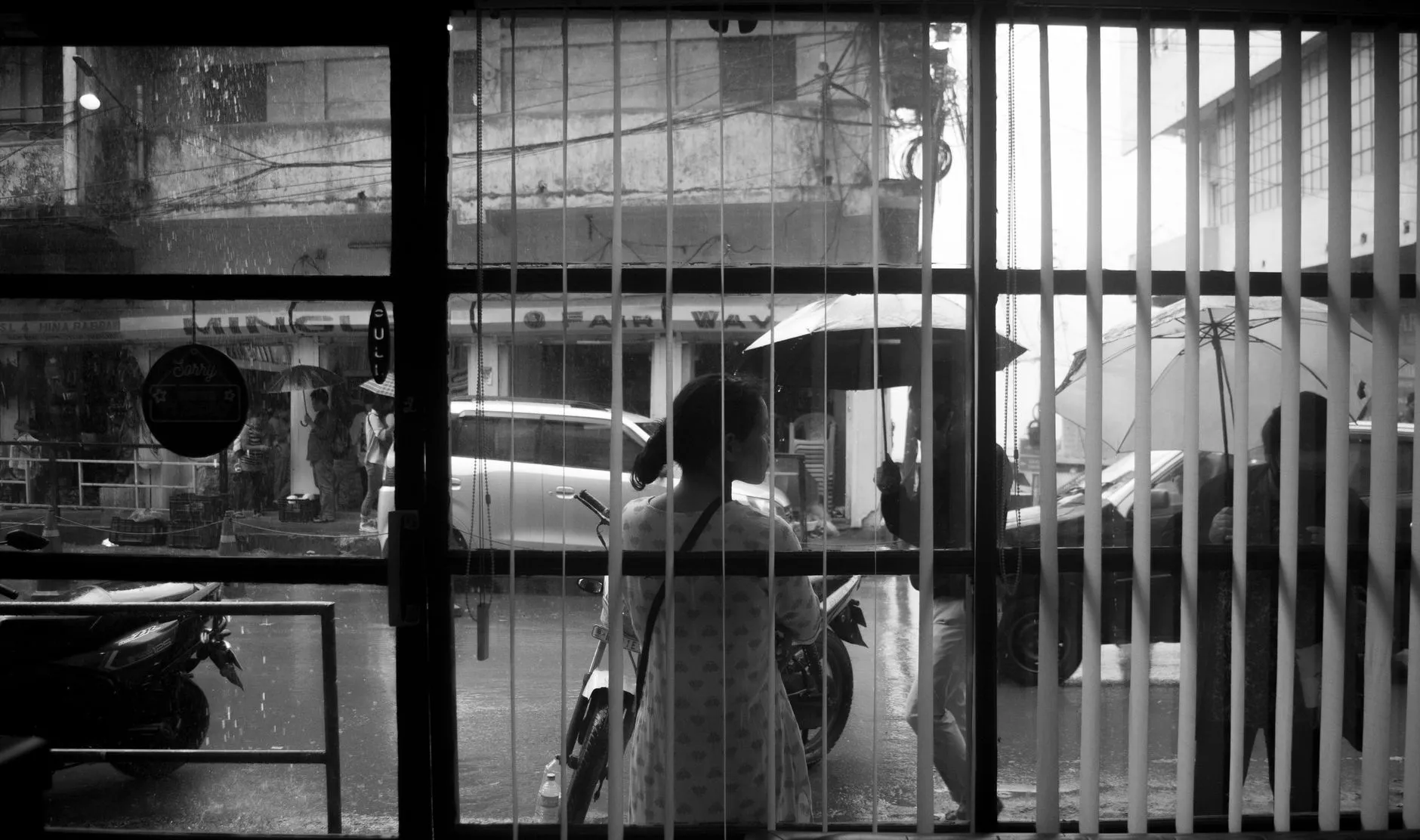
| Watching rain fall from inside, through a window | The glass barrier is significant: the dreamer observes the emotional and transformative forces of rain without being touched by them. This configuration often points to emotional detachment, a protective distance from feeling, or a sense of being excluded from the vitality and change that others around the dreamer are experiencing. It may gently ask whether the dreamer is ready to step outside. |
| Rain falling only in one specific location or on one person | Localized or targeted rain in a dream draws attention to a particular relationship, situation, or aspect of the self. If it falls on someone else while the dreamer stays dry, it may express unconscious guilt, pity, or projection. If it falls only on the dreamer, the dream may be highlighting a sense of being singled out, burdened, or specially chosen — depending on whether the rain feels like punishment or grace. |
| Rain that is an unusual color (red, black, golden) | Colored rain intensifies the symbolic register. Golden rain often carries archetypal resonance with divine abundance or creative inspiration — and in Jungian terms echoes the myth of Danaë, fertilized by Zeus as golden rain. Black or red rain typically signals contamination, danger, or a warning that something in the dreamer's environment is not what it appears to be. These dreams invite careful reflection on what is falling into the dreamer's life uninvited. |
What does rain symbolize in dreams?
Rain in dreams operates on multiple registers simultaneously, which is precisely why it recurs so frequently and remains so memorable. At its most elemental, rain crosses the boundary between sky and earth — it is the connecting medium between the above (spirit, thought, the unconscious) and the below (body, practical life, the material world). This liminal quality makes it a natural vehicle for communication between levels of the psyche. Ernest Hartmann's research on the boundaries of the mind (1991) offers a useful modern frame: dreamers with thin psychological boundaries — those who are more emotionally permeable, creative, and prone to vivid dreams — report rain imagery far more frequently than those with thicker, more defended boundaries. For these dreamers, rain is less a symbol to be decoded than a direct somatic experience of emotional life flowing through the dreamed body. Calvin S. Hall's large-scale empirical study of dream content, summarized in 'The Content Analysis of Dreams' (1966), found weather conditions — including rain — to be among the most common environmental elements in reported dreams across multiple cultures. Hall noted that weather in dreams correlates strongly with reported emotional tone: precipitation tends to accompany dreams rated as emotionally intense, suggesting that rain functions not merely as backdrop but as an externalization of inner weather. Ann Faraday, in 'The Dream Game' (1974), encouraged dreamers to ask: what does the rain feel like on your skin? Her phenomenological approach reminds us that the texture of dream-rain matters as much as its narrative context. A dream in which rain feels luxurious and warm signals something entirely different from one in which it feels cold, invasive, or impossible to escape.

Frequently asked questions
- Is dreaming of rain a good or bad omen?
- Neither categorically. Rain in dreams is one of the most context-dependent symbols in the oniric vocabulary. Gentle, warm rain is almost universally interpreted as positive — cleansing, nourishing, and renewing. Heavy storms or cold downpours lean toward emotional overwhelm or external pressure. The most important interpretive clues are: how did the rain feel? Were you sheltered or exposed? Did you welcome it or flee from it? Your emotional response within the dream is your most reliable guide.
- Why do I keep having recurring dreams about rain?
- Recurring rain dreams typically signal that the psyche is returning to an unresolved emotional theme — something the conscious mind has not yet fully processed or acknowledged. Ernest Hartmann's boundary theory suggests that these dreams intensify during periods of emotional stress or personal transition. Rather than seeking a single definitive interpretation, pay attention to what changes between recurrences: is the rain getting heavier or lighter? Are you gradually finding shelter, or becoming more exposed? The progression of the series often tells a story of psychological movement.
- What does it mean to dream of rain indoors — water coming through the ceiling?
- Rain entering a building, particularly the home, combines two potent symbol systems. The house in dreams typically represents the self or the psyche (as Jung extensively documented), and water penetrating from above may suggest that emotions, unconscious material, or external pressures are breaching boundaries the dreamer believed were secure. This dream often appears during periods when personal boundaries have been tested — in relationships, at work, or around creative projects — and invites reflection on where reinforcement or repair is needed.
Sources and references
- Freud, Sigmund. The Interpretation of Dreams. (1900). Trans. James Strachey. Basic Books, 1955.
- Jung, C. G., et al. Man and His Symbols. Doubleday, 1964.
- Hall, Calvin S., and Robert L. Van de Castle. The Content Analysis of Dreams. Appleton-Century-Crofts, 1966.
- Faraday, Ann. The Dream Game. Harper & Row, 1974.
- Hartmann, Ernest. Boundaries in the Mind: A New Psychology of Personality. Basic Books, 1991.
- Artemidorus of Daldis. Oneirocritica (The Interpretation of Dreams). Trans. Robert J. White. Noyes Press, 1975.
Comments
…